Friday, July 16, 2021

My Life with Master (30-01-21)


I’m not really ready to write anything about this but unless I play it my recollection will just get worse, and right now I'm unlikely to play it so...

I picked this up as I had seen people raving about how original and influential it was, I tried to purchase it from its own site, but its so old (2003) I ended up being sent the pdf by the actual author! The thing it reminds me of the most is Sorcerer and the designer (Paul Czege) cites Ron Edwards as his big inspiration.

The player characters are the minions of some evil genius type like Victor Frankenstein, and the few rules that there are serve to shape a story that will end in the master’s death at their hands. 

The Master is mechanically represented by a Fear value, the environment’s ability to resist them is embodied as Reason, the Minions have Self Loathing and Weariness and their one saving grace, which will cause the master’s doom is Love. The players and GM design the master and their characters in a collaborative fashion with a few elegant rules for defining abilities and character.

The game is then played in Scenes with each player taking one in turn, these tend to end on a dice roll (which will push up at least one of their stats) before moving onto the next player. The balance of stats dictates much of what happens - indeed it's when someone manages to resist Master’s command (which wont happen till their Love has increased) that the end game begins.

It feels like a cleverly calibrated story machine, based on an analysis of these kind of horror movies. I don’t think I’ve ever seen such a meaningful set of rules before, as in so intentionally expressive of a take on the world.

Oh and its worth saying, the game makes no effort to tell you what the rules mean, it just hits you with them.
 

Greg Costikyan's MLWM blogpost  is also really interesting…

“To put it another way, a standard RPG is character-centric; its rules define a set of abilities that each character possesses, and the rest is up to the gamemaster and players to negotiate. Master is, by contrast, narrative-centric; its rules define a narrative arc from which there is no escape, and the rest is up to the gamemaster and players to negotiate.”

The full thing can be found here and his actual review which is equally as interesting is here.

I seem to have spent much of my evening reading around MLWM now (including tangentially finding out much more about GC and ordering his book on Uncertainty In Games) - this is from an interview with Paul Czege:

I think intentionally designed RPGs can be better at changing people’s behaviors and beliefs than other media. Playing an RPG imprints its template for how the world works deeply into your brain. My Life with Master infects players with its understanding of the workings of controlling relationships, and how to get out of them. Imagine the social and economic impact of a truly fun roleplaying game that infects players with an ability to resist powerful advertising messages and more consistently make purchasing decisions they feel good about in retrospect.

The full interview is here

Fascinating stuff, I definitely have to actually play this one day.

Thursday, July 8, 2021

Mork Borg (28-01-21)


As much a work of art as game I think, a punk zine aesthetic with prestige format production values; varied paper types, embossed cover etc, it is a beautiful little artifact. Its random tables seem as much evocative performance as actual rules, not to slight the content. Everything is both incredibly concise and super expressive. I feel like you could open it and just start playing.


‘A doom metal album of a game. A spiked flail to the face. Rules light, heavy everything else.’


Like the VtM core rule book it starts with lore presented directly, a dozen pages or so of a world inspired by metal and medieval millennialism, more Bosch than Tolkien.


The rules are fairly simple and I was going to say hark back to D&D (I feel, with limited knowledge that the system is inspired by Knave and the whole OSR thing - having not actually read Knave yet, though I have dipped into Rakehell) but that may be lazy thinking on my part.


On the face of it it's not terribly mechanically interesting, save that it throws in random tables with eclectic results wherever it feels like it. Random is king. It screams, 'Just roll it! Now!' It feels very anti-math, anti-system.

For action resolution its a roll greater than or equal to a Difficulty Rating system. Throw 1d20 and add the relevant Ability, a normal difficulty being DR 12 with ability scores range from -3 to +3. Abilities (there are 4; Agility, Presence, Strength, Toughness) are rolled like D&D stats on 3d6, but you simply keep the bonus part (a 13 say would give you +1) and throw away the roll.
Like PbtA the enemies don’t roll (I think), the player simply rolls their attack & defence each round, giving and/or taking damage as the dice dictate.


The one stand-out rule character wise is ‘omens’ which are much like fortune points in Conan (re-roll one die, do maximum damage etc) except you are not awarded them but rather have d2 or whatever each day.

I wonder what it would be like to play, I suspect the appropriate way would be with loads of random tables, yet the sample adventure is not really like that, it has a fixed floor plan with some nice details linking its contents.

Oh and how could I forget (because the mad formatting!) - the Calender of Nechrubel. You roll to see when the world will end, each day the GM rolls to see if a misery is activated. Miseries are presented as Psalms. “6:6 And the unnamed enter the earth, passing through the Veil as it is sundered by Daejmon, the left underling of Nechrubel.

Here’s rpg designer Chris Bisette rolling up 2 Mork Borg characters.

And here’s its own brilliant character generator - its a one click wonder of a thing!

And and here's the official Mork Borg website with shop links etc.

Saturday, July 3, 2021

Conan (23-01-21)


I actually read this quite some time before Feng Shui but I've just rolled up a character using the Modiphius webapp and skimmed the action mechanics again to write this up now.

This is the Modiphius Conan game from 2017 using their '2d20 system', with the unwieldy subtitle 'Adventures in an age undreamed of' (which always makes me think of a Chris Morris bit from the IT Crowd). It is a beautifully illustrated book, with just over 400 pages providing the rules and plenty of resources for adventuring in Robert E Howard's Hyborea, including a starter adventure.

Character creation is detailed and evocative with each stage of the process involving assigning or modifying stats as the result of some background story consequence.

You start by picking your homeland, then your basic attributes (Strength, Awareness, Brawn, Coordination, Intelligence, Personality & Willpower), modify these according to ‘Aspects’ (Fast & Fit, Eagle-eyed, Socially Adept etc), then roll or pick Caste (social class) and so on. The system can clearly produce a really varied range of characters with interesting details including story hooks in the form of  Events with Traits which double as a device for the player to regain Fortune Points.

Most characters start each session with 2 Fortune Points, these can be spent on bonus dice for skill tests, gaining additional actions in combat or influencing the story in some way. The GM awards Fortune Points to the players throughout a session as rewards for achieving aims, good role playing etc.

The character I rolled up was from the Priesthood caste and got the 'A place in need of Guidance' event resulting in the ‘Shrine Guardian’ trait

I could potentially invoke this trait in play by having members of my scattered congregation appear looking for help, or make the noble nemesis of my faith be the friend of some NPC we are bargaining with, and thus have the GM replenish my Fortune Points as a result. Note there is not much guidance on the specifics so its  very much reliant on player creativity and GM ruling.


For me the standout game mechanic is Momentum.

Skill tests are a little like the White Wolf Storyteller system of rolling dice against a target number and counting the number of successes. The difficulty of a task dictates how many successes are required, and in the default situation the character gets 2d20 to try to achieve that. A success is any die roll under the sum of the relevant attribute and skill values. 

For every success more than the quantity required for the task the player gets a point of momentum. This can be used immediately or stored in the party pool for later (to a maximum of 6). Momentum can be spent by anyone to gain extra dice for a skill test, extra damage dice, inhibit an enemy action, glean more detailed information from some inquiry roll, or increase the quality or scope of an action.

This sounds like a lot of fun to me and judging by Seth Skorkowsky's review it facilitates team play and is conducive to the heroic action outcomes you'd find in the source material (as you can boost your actions up to cut heads clean off etc).

The GM has their own version of Momentum - Doom Points. In general the game is rigged in the players' favour; they always win initiative, weak enemies are downed in one blow etc. Doom points provide the GM with a systematized method for overriding this on dramatically appropriate occasions. They start with as many as the sum of all the players' Fortune Points and more are added as a result of player actions or circumstantial effects. Like momentum, doom is represented by a pool of physical tokens on the table, likely contributing tension as the pool builds.

I'm sure there are a load more interesting rules in Conan, but without rereading that whole big book I'll need to leave them for now. Overall it looks like a fun game with plenty of interesting systems for emulating the Conan stories, although I don't remember playing any rpgs back in the day with such meta-gaming systems at their core, so I have no real idea of what that would be like.


Thursday, June 24, 2021

Feng Shui 2 (04-01-21)


Feng Shui is a system for creating Action Movies games, specifically Hong Kong action movies. It was the System Mastery podcast which put me onto it, I really doubt I’d have looked at it otherwise as the setting it is not a natural one for me, although the designer is Robin D Laws who was involved with Over The Edge (the 2nd ed is actually dedicated to him) and the writer of Hamlet's Hitpoints, which I happened to order at the same time.

The first edition is from 1996 and although I don’t know what they've changed since I get the impression that this game was hugely influential, especially on ‘Fiction First’ games like Fate. It is a fairly simple system with the emphasis on creating fast paced dramatic action.

Players choose from one of 36 'Character Archetypes’ to play, which are more like playbooks from PbtA than D&D character classes. The idea is to take them as is, fill in the personal details (name, concept, ‘melodramatic hook’) and make any small modifications you like. 

There is no actual character creation system as such. The archetypes range from 'Everyday Hero' to 'Transformed Crab', with each listing its special abilities (‘Schticks’), stats, skills and advancement details. An aspect I really like is 'buying in', i.e. it is up to the player to say why their character is here getting involved in the action, not the GM.

The dice roll mechanic is possibly closest to Fate; you throw 2 dice, and subtract one from the other giving you a base value from -5 to +5, only it has exploding sixes so the numbers can get very high or low. To this you add the stat or skill relevant to the action, and the degree to which you beat a difficulty target set by the GM dictates the details of the success or failure. 

You can spend a point of Fortune (one of your stats, replenished at the start of each session) to gain an extra die towards your action, bearing in mind that Fortune is also the basis of luck rolls and the expendable resource required for magical abilities (should you have any).

Mechanically the element of Feng Shui newest to me is its initiative system. At the start of every combat ‘sequence’ (essentially a round) each character rolls 1d6 and adds their Speed stat. This is the ‘shot’ you start on, with the highest shot going first. Most actions take 3 shots. So if your total was the highest with 12 you would start on 12, if the next highest was 10 that character would go on 10, then you would get another action at 9 and so on. Once all shots are used up a new sequence begins and initiative is re-rolled. There are also modifiers to combat outcomes based on how long a fight has gone on, presumably to try keep things from getting too drawn out.

As with OTE a substantial chunk of the book is dedicated to the setting, providing a solid basis for just about every flavour of HK action flick. There are 4 time zones; the ancient, the past, the present and the future, over which different factions vie for control. Power is exerted by controlling ‘Feng Shui’ sites. Portals facilitate movement between these zones which behave more like places than times, making paradoxes impossible, although you can still change an entire zone by taking enough of the Feng Shui sites of another zone upstream.

This looks like a really interesting and fun game with innovative, fairly light-touch, player empowering mechanics. Cowabunga!

Wednesday, June 16, 2021

Over The Edge (05-09-20)

More setting than system, OTE takes place on a fictional island in the Atlantic, like Interzone from Naked Lunch but where every conspiracy you can think of is true. Psychic powers and sentient baboons share space with aliens, demons and celebrities. I was thinking it was very Robert Anton Wilson inspired, but then they call out William Burroughs as their main muse towards the end of the book. It was Ron Edwards’ notes in the annotated Sorcerer which led me here, I think he explicitly mentions some rule from the first edition.

Mechanically the game it reminds me of the most is Sorcerer (and FATE) - the rules are very simple, built for storytelling and drama, it’s an elegant system. There is very little in the way of character stats - you decide a Main Trait (Heretical Exorcist say) and a Side Trait (with Jihadi combat training) and can do anything that would fall under these to a numerical extent defined by your level (1st to 5th). Critically you also pick a Question Mark which defines your character and will likely serve as a tool for the GM (Hard hearted? Wise? Determined etc) and similarly a Trouble (I let curiosity get the better of me, I always have to show off). There are no mechanical aspects to these but they do serve as a way for the player to say to the GM and other players 'these are the kind of situations I want to deal with'. And that is pretty much it for characters.

Dice rolls are referred to as ‘lots’ and the idea is that you throw them rarely - generally one roll would cover a whole combat or action. It works like this - throw 2d6, if you have the initiative you succeed on 7+ otherwise it’s 8+. For each level difference between you and the difficulty of the task you either get to re-roll a die or have the GM force you to re-roll. A 3 will you get a ‘Bad Twist’ and on a 4 you get a ‘Good Twist’. Rolling a double gets you Karma; a free re-roll to use later.

I like it, especially the rules (out of a 250 page book the rules make up the first 50 pages) but if I could only play one RPG out of all the ones I’ve read lately this wouldn’t be it.

Saturday, June 12, 2021

Your Adventure Starts here...


A little over 2 years ago the company I was contracting with pitched a video game concept to a publisher based on a tabletop role playing game that the publisher owned. To our surprise they showed an immediate interest and asked for more information, usually these things take ages. I had nothing to do with the actual pitch, but given I was working there as a designer I needed to catch up fast and come up with that ‘more information’.

Back in the day (as they say on the Grogpod) I played a lot of role playing games, starting with the Moldvay Basic D&D boxed set which I’d asked from Santa in, hmm maybe 1982. Basic soon led to Advanced, then Traveler, Call of Cthulhu, Middle Earth Role Playing and on and on for the next ten years. At some point we switched to playing games of our own devising, Frankensteined things cobbled together from many systems. My first forays into game design I guess. 

I was an obsessed and shameless rpg nerd. One time I even managed to get my whole 2nd year English class playing D&D for a lesson (thanks Mr Strachan!) and I was a founding member of the school D&D club at a time when there were no other such after school clubs* due to it being the height of Thatcherism.

The game IP for which my colleagues were pitching was not one of those I had played however, so I started reading. My response to the material went from cringe to obsession in a few days. By the time we met the publishers in person I had gone fully native, speaking its abstruse language with confidence. The project got signed, so it turned out my research was just beginning. 


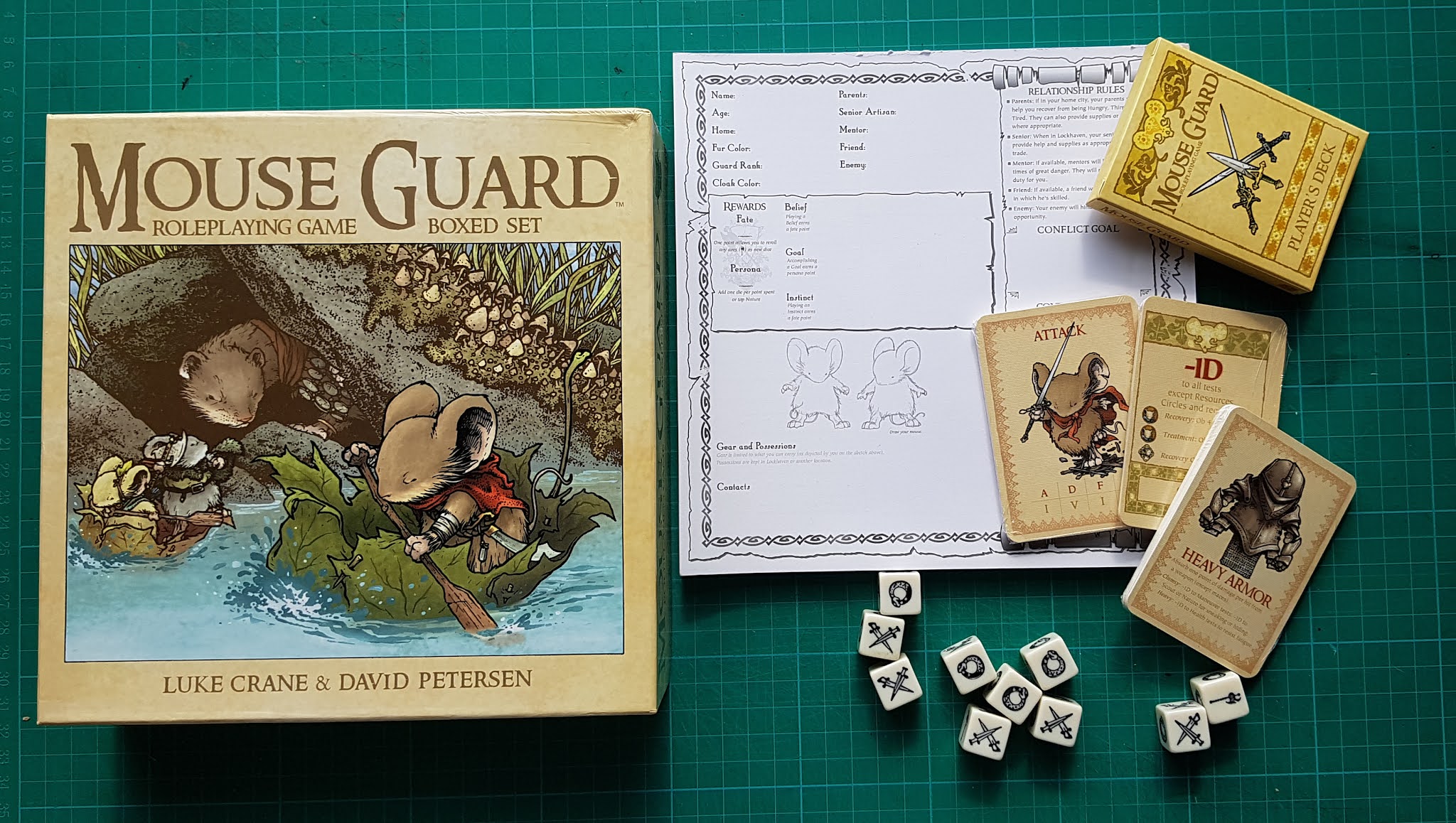
Although I was loving the material we were working on, it was reading this reddit thread - that got me looking at other systems. The thread asks for examples of rules which didn’t sound great on paper but were brilliant in play. The details people listed blew me away - it was the first time I got an inkling of how far things might have moved on since I last played. As a result I ordered Mouse Guard, then Dungeon World, then Blades in the Dark, then… well see the pic at top, plus there's more in the post not to mention a bunch of Kickstarters still to be fulfilled.

I wasn’t actually playing these games though, only reading them and trying to imagine how the rules would play out and glean whatever I could for the work project. At some point I realized I needed to start taking notes or I’d forget what I’d read in a few weeks. So starting with Over the Edge I would jot down my thoughts on each system when I finished reading it.


Sadly the work project got canned at the start of this year. I’m not at all sure what I can say about that so I’m going to play it safe and say nothing. It was a great opportunity which just didn’t work out. So it goes. The key thing here is that it rekindled my love of ttrpgs and now I'm always in the process of reading some system with at least one or two more laying in wait on the living room table.

I am also still writing up my thoughts which is why I’m writing this. I thought I might (gradually) post all the notes that I’ve taken to date and then post new ones as I write them, this being instigated as much as anything by the fact I now follow and read a lot of great rpg blogs. These notes are not reviews, and at the time of writing them the main thing was to outline the key rules and features for ease of comparison later. I have not played any of these games, well other than the solo journaling ones, only read them, which is ironic given that reddit post which nudged me into buying Mouse Guard and set me off on this adventure in the first place….

Thanks for reading :)

*there was one other club - a martial arts one run by a teacher who was eventually fired for pointing an air rifle at a pupil, but that's another story